
Angelo Angelopolous
2026
By Mark Monteith
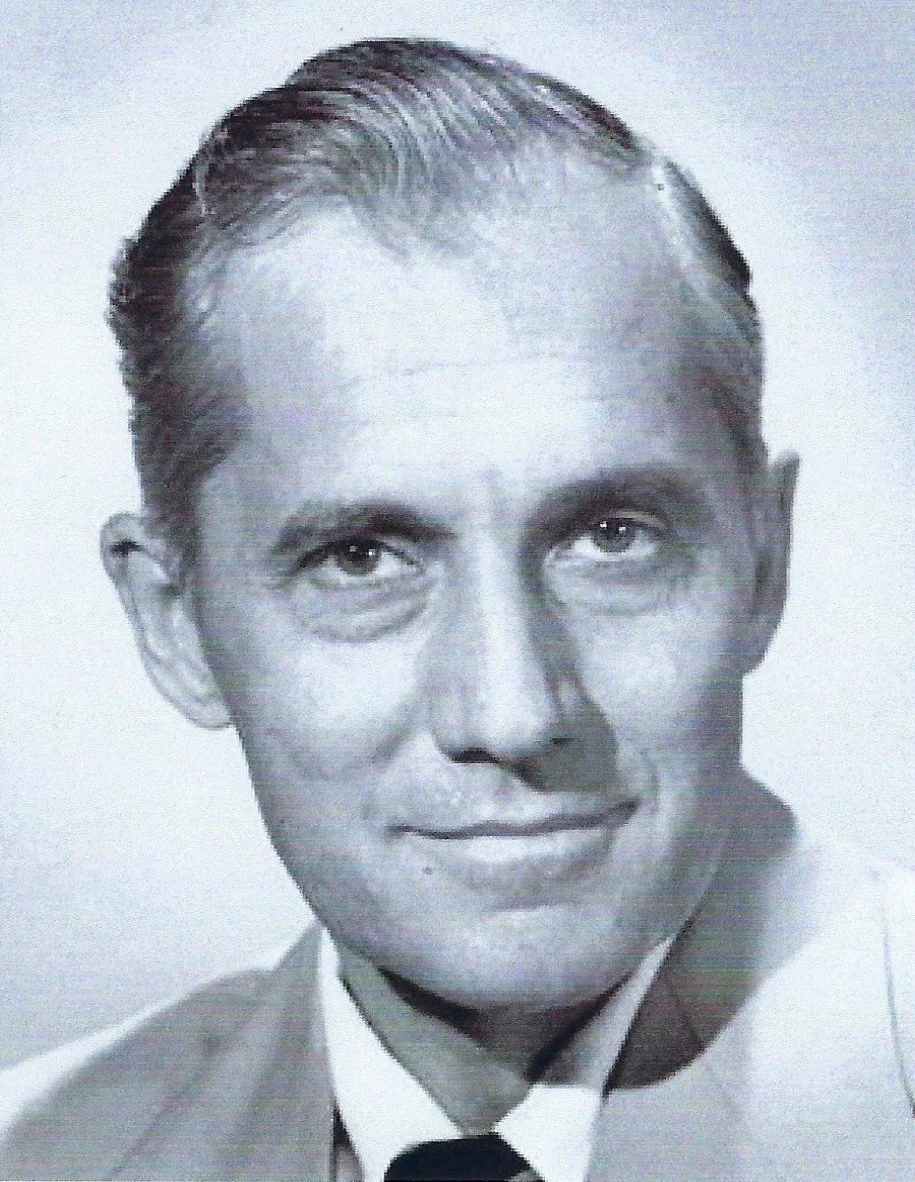
Angelo Angelopolous was a talented, popular, handsome and courageous journalist, a nationally acclaimed sportswriter who had it all.
Until he became a tragic figure, gone too soon.
The Indianapolis native was born in 1919, one of five children who grew up amid humble surroundings that gave no hint of the polished man he would become. His father, a Greek immigrant, operated a grocery store on the city’s west side, and the family lived above it. Angelopolous, upon graduating from Manual High School, enrolled at Butler University and quickly established himself as a prodigy. He was editor of both the campus newspaper and yearbook, and joined or was inducted into several academic, social and journalism organizations.
The Indianapolis News, the city’s afternoon daily, identified him early on as a special talent and hired him as its correspondent for Butler athletics. The News then snapped him up with a full-time position shortly after his graduation in 1940. Just 18 months into his burgeoning career, however, Pearl Harbor was bombed. Angelopolous answered the call to duty by joining the Navy. He breezed through flight training and served as an instructor for advanced training squadrons in Texas and Florida, then joined the Pacific war operations.
His final wartime duty as a pilot was to fly over and inspect the bombed Japanese cities, including Hiroshima. He was discharged from the Navy four months later. The News greeted him as a war hero, with a story headlined “And Now He’s Back!”
Resuming his sportswriting career, he quickly established himself as one of the nation’s best. He wouldn’t have claimed that, however. He was a soft-spoken man who was popular among his colleagues because he possessed the rare combination of talent and humility. Bob Doeppers, a photographer, summarized Angelopolous perfectly: “He never met anybody who forgot about meeting him.”
Fittingly for a low-ego journalist, Angelopolous wrote about sports at all levels. Youth league, high school, college, pros, it didn’t matter; he went wherever stories were to be found. One example: He went to the YMCA on Senate Avenue -- known locally as the “Colored Y” because it was the only one in the city that admitted Blacks -- to write about a summer pickup basketball game involving some of the best players in the area.
He didn’t limit his interests to sports, however. One of his career highlights was a multi-part series on his trip to Greece, his father’s homeland, that ran on Page 1 of The News.
Although he worked for a conservative newspaper in a conservative state, he advanced a progressive social viewpoint. Covering Crispus Attucks High School’s state championship victory in 1955, he wrote, “A Negro team, for the first time, has won the highest athletic honor the state has to covet … and you want to say that man, at least in this little section of the world, has taken a step forward.”
Barely more than two months later, however, he had to write what surely was the most difficult story of his career. Bill Vukovich, winner of the Indianapolis 500 in 1953 and 1954, did not let many people into his inner circle. But he and Angelopolous became fast friends. When Vukovich was killed in the 1955 race while racing toward his third consecutive victory, Angelopolous had to report on it for The News.
He handled it elegantly, keeping his emotions in check. He wrote the main race story on Bob Sweikert’s victory and a tribute column on Vukovich that displayed the greatness of both subject and author. He wrote:
“Under the crust and behind the calculated hyperbole he spread among fellow race drivers, there was a warm soul in this tremendous two-time 500-Mile Race winner hell-bent for a third straight triumph. He had sense of humor, backed by a crinkly grin, that brought a smile even to those who had just taken the full force of his barb. He could peel the hide off the man who took himself too seriously, and Bill took himself seriously least of all.”
That challenge paled in comparison to what would soon confront him. At some point that year, perhaps shortly after the race, he was diagnosed with leukemia. His wife, Joann, was later informed in a letter from a government official that nine of the 16 pilots in Angelopolous’ flight squadron had contracted the blood disorder from the radiation absorbed during their post-bombing missions.
Angelopolous accepted his fate as courageously as he approached a war mission. He never wrote about it, never advertised it, but didn’t try to hide it. He aged prematurely over the following years, gradually dwindling to a skeletal collection of skin and bones, but he charged onward.
He and Joann moved to New Jersey, where he was better positioned to work as a freelance writer for national publications. Three of his stories would eventually appear in annual book compilations, Best Sports Stories. He maintained his relationship with The News as a correspondent as well. He made several trips into Manhattan to write features on Indiana sports personalities, such as basketball star Oscar Robertson, who performed at Madison Square Garden, but also covered non-sports figures. They included Indiana University president Herman B Wells and a United Nations delegate who spoke on Russia’s space program.
All the while he labored over his pet project, a biography of Vukovich. He had a contract with an Indianapolis publishing firm, Bobbs-Merrill, but for unknown reasons it never made it to print during his lifetime. The book eventually was published in 2024.
Angelopolous and his wife moved back to Indianapolis in 1960 to live out his remaining months near friends and family. Attending sporting events became impractical because of his declining health, but he kept working. He wrote feature articles for the entertainment section less than six weeks before he died Oct. 14, 1962. He was 43.
His reputation was such that his death merited mention in newspapers throughout the United States and Canada. The most fitting tribute, ironically, appeared in a competing newspaper, The Indianapolis Star. Bob Collins, who succeeded Angelopolous as the city’s pre-eminent sports journalist, devoted his column the next day to his friendly rival.
One paragraph in particular served as a summary eulogy:
“I remember first reading his stuff years ago and thinking, ‘If there are many in this business as good as him, I’ll starve to death.’ And I remember my joyful surprise upon later discovering that he was the warmest and kindest of men, a delightful companion, a friend who would back you to the limit – and fierce competition.”
Angelopolous indeed had it all. Except fate’s gift of longevity.